
spent learning and tramping about fields and meadows at Brookfield Farm at the end of June, the timing of our introduction felt significant.
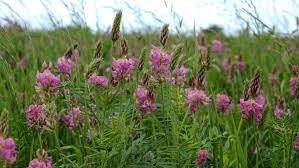
For centuries, sainfoin (which translates from French as “healthy hay”) enjoyed widespread pride of place in traditional land cultivation throughout the world. So ubiquitous was this forage legume in the U.K., it is said that one in seven fields in southern England were covered in its pink flowers until the mid-1940s. Considered by farmers as the ‘best cog in the farming wheel’, it was recognised for its successful and beneficial use in pasture fields as fodder for ruminants, but also as a miracle crop that gave back to the soil. Sainfoin boasts so many benefits to humans, grazing animals, and the planet alike that it seems incredibly nonsensical for it to have ever fallen out of favour. When you understand the context behind its decline in popularity, though, things start to make more sense. As the penny drops, I challenge you not to nod in a knowing and jaded manner. Why did sainfoin lose popularity? Sainfoin was just one victim of the creeping loss of long-held wisdom and knowledge about crop diversity and soil health as the industrialisation of agriculture and “yield is king” era pushed other more “productive”, more “efficient” crops up the pecking order. Farm support payments of this era insisted upon prioritisation of intensive production and output. Creation of and reliance upon a monoculture of crops decided upon as the most reliable (and use of synthetic fertilisers to enforce this reliability) was deemed to be the answer. At the time, sainfoin’s tendency towards inconsistent yield and slow regrowth meant it didn’t make the cut. As is often the case, decisions or paths taken that seem ridiculous to us in hindsight, with the benefit of that hindsight and of the information available to us now, can be more easily understood if viewed through the lens of the mainstream thinking that led the charge at the time. Of course, the disappearance of sainfoin from our land dovetails with this ethos of the post-war Green Revolution. But the times are changing. For those involved in regenerative and sustainable agriculture, interest in the powerhouse that is sainfoin is enjoying a resurgence. Benefits of sainfoin The benefits of utilising sainfoin in agriculture are manifold. In contrast to many of the cereals and grasses currently used in pasture, sainfoin, as a member of the forage legume family, offers high protein content and more effective utilisation of that protein within the animal’s system. Another digestive benefit of sainfoin is down to the tannins it contains, which help to prevent bloating. Nutritious, organic, filling food for happily grazing sheep and cattle can only be a good thing, but this is not the only plus - limiting bloating also means reduced ammonia and methane emissions, and we know how pressing of a concern reducing greenhouse gas emissions from the agricultural sector is. Sainfoin is also known for its ability to “fix” nitrogen from the atmosphere, ie: to sequester it in the soil and use it for the benefit of both its own growth, and the growth of any crops grown either with it or after it. While many plants unfortunately lack the capability to access and utilise the abundant nitrogen available in the atmosphere, the way sainfoin manages it is fascinating to learn about. Sainfoin partakes in a symbiotic process whereby bacteria with the ability to break nitrogen bonds make their home within the sainfoin plant, thus acting as its own personal pure nitrogen provider. It goes without saying that this natural process of providing nitrogen for plant and soil health is preferable to the use of its synthetic counterpart. While sainfoin is working its magic at fixing nitrogen back into the soil, it can tolerate low quality soil - this is particularly important to consider given the depleted nutrient value of much of our soils at the moment. In fact, there is evidence from the 1800s that tenant farmers were required to use sainfoin in order to maintain soil fertility. Further, due to this nutrient sequestration, as well as the way it responds to heat and light, sainfoin will actually produce higher yields as the planet grows warmer. It has also been proven to be both drought and frost tolerant. This is in contrast to many other forage legumes currently in use, such as alfalfa and clover, which have been shown to struggle with the abrupt and extreme changes in weather. This is just another way in which re-integration of sainfoin makes utter sense in a world where agricultural practices need to be adapted to the challenges presented by climate change. Sainfoin’s welcome contribution towards tackling our climate and biodiversity crises doesn’t end there. Through its ability to fix nitrogen, we have already seen how sainfoin is a dream come true for soil health and biodiversity. As a rich source of pollen and nectar, sainfoin is extremely attractive to pollinators of all types, meaning it also does an incredible job at promoting biodiversity of, and maintaining stability of, local ecosystems. While pollinators are welcome, pests and disease are not. Taken alongside many of its fellow legumes, sainfoin is known to be comparatively rather resistant to potentially serious pest and disease problems. On the topic of disease, sainfoin has long been lauded for its medicinal properties, even referred to in Italian as “herba medica”. The tannins in sainfoin have been shown to have potential as an untapped natural resource in replacing the need for anthelmintic (anti-parasitic) drugs in animal farming. Biological solutions are much preferred to these medications - not only do these drugs become increasingly ineffective as resistance to them builds over time, finding natural ways to combat against illness and disease is an overall kinder, healthier, and more cost-effective solution than relying on regular administration of drugs. In the face of threats to the status quo of current agricultural systems posed by climate change; in the face of worries about inconsistent or non-existent harvests of crops whose seasonal reliability we have carefully managed but are now less able to predict, sainfoin is a shining beacon leading us down a new path for the changing seasons we now must adapt to. Conclusion Huddled under the protection of some nearby trees while the unseasonal wind and drizzle did its best to steal away our enthusiasm, I encountered sainfoin for the first time. It captured my attention so fully because it is an emblem of some of the most pressing questions, we need to turn our attention to: why we have allowed ourselves to lose so much knowledge and diversity, and how to rethink our current food and farming systems in a way that acknowledges the significance of this loss, and attempts to redress it. If blindly continuing with a now broken food system that we created to solve problems from half a century ago is the problem, the answer is taking lessons from the past, incorporating them with new knowledge and applying them for our current reality. The story of sainfoin is not a unique one. We have forgotten, and are on the verge of losing, countless food varieties worldwide - varieties that could be pivotal in helping us to face catastrophes to come. Sainfoin can serve as a starting point in considering this. It shows that protecting and reintroducing the wisdom, techniques, and diversity we have allowed ourselves to lose or to ignore is integral in building kinder, healthier, more equitable and sustainable, less extractive, regenerative food and farming systems. Resources Carbonero, C. H., Mueller-Harvey, I., Brown, T. A., & Smith, L. (2011). Sainfoin ( Onobrychis viciifolia): a beneficial forage legume. Plant Genetic Resources, 9(01), 70–85. https://doi.org/10.1017/S1479262110000328 Sheppard, SC, Cattani, DJ, Ominski, KH, Biligetu, B, Bittman, S, McGeough, EJ. Sainfoin production in western Canada: A review of agronomic potential and environmental benefits. Grass Forage Sci. 2019; 74: 6– 18. https://doi.org/10.1111/gfs.12403 Kelly Girardi Instagram @kelly_girardi Linktree kelly_girardi
0 Comments
Your comment will be posted after it is approved.
Leave a Reply. |
Categories
All
Archives
March 2024
AuthorsRecipes from Katie Verling & Jacques |
 RSS Feed